.png)
City Hunter Review – Nintendo Switch

By Justin D Williams
City Hunter on Nintendo Switch is the kind of rerelease I appreciate because it understands exactly what it is: a preserved piece of anime gaming history rather than a modern reinvention. Originally released for the PC Engine in 1990, the game follows Ryo Saeba through a collection of cases involving criminals, kidnappings, shady organizations, and eventually a larger conspiracy. I found the story fairly simple, and it feels more like a handful of City Hunter episodes connected together than one major narrative campaign, but the official English localization makes a huge difference. Being able to actually follow the dialogue and understand what characters want from me made the experience much more enjoyable, especially since conversations are often tied directly to progression.

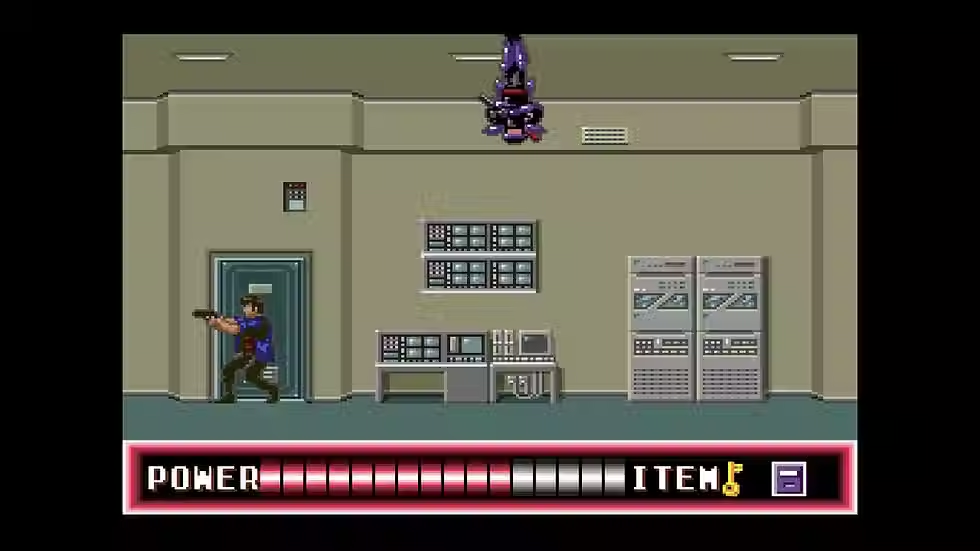
Gameplay mixes side-scrolling shooting with light adventure elements. I spent most of my time exploring buildings, entering rooms, talking to characters, collecting items, and shooting through enemies until I could reach the boss. The shooting is straightforward and works well enough, but I found navigation to be the bigger challenge. A lot of the hallways and rooms look almost identical, and without a proper map, I sometimes found myself going back through the same areas trying to remember which doors I had already checked. Enhanced Mode helps the overall experience by improving responsiveness and cleaning up some of the original game's rougher edges, while save states and rewind made some of the more frustrating moments much easier to deal with.
Visually, I think City Hunter still has plenty of charm. Ryo's sprite, the character portraits, and the anime-inspired presentation all capture the late-'80s and early-'90s feel of the franchise really well. I especially liked how the game retains its original pixel-art identity instead of trying to completely modernize everything. The biggest visual weakness for me is the repetition. I saw a lot of similar-looking corridors, offices, and rooms, and that repetition does more than make the game look dated because it also makes navigating the stages more confusing. Still, when I looked at it as a preserved 1990 game rather than a modern action title, I found a lot to appreciate in the presentation.
The music was easily one of my favorite parts of the game. The soundtrack has that classic Sunsoft energy and fits City Hunter extremely well, giving even the simpler action sequences more personality. I also liked having access to the music player and gallery because those extras make the package feel like a celebration of City Hunter rather than just an old game dropped onto modern hardware. Replay value is limited because the campaign is short, but Original Mode, Enhanced Mode, and Hard Mode give me more reason to return than I initially expected. Hard Mode in particular changes enough enemy behavior, item placement, and difficulty to make another playthrough worthwhile, though I don't see this being something I would continuously return to after experiencing everything it has to offer.
Overall, I enjoyed City Hunter, but I also can't ignore how dated parts of it feel. The combat is simple, the environments become repetitive, and navigating nearly identical areas can become tedious, but I still found plenty of charm in its music, pixel art, personality, and historical value. I especially appreciate that this rerelease finally gives Western players an official way to experience such an obscure piece of City Hunter gaming history in English. I wouldn't call it a forgotten masterpiece, but I do think it is worth checking out if you're a fan of the anime, Sunsoft, or retro games in general.


Comments